
Mobile app development with React Native has revolutionized the way we build cross-platform applications. At RayaTech, we’ve seen firsthand how this framework can streamline development processes and reduce costs.
React Native’s promise of “write once, run anywhere” has attracted developers and businesses alike. But is it the right choice for every project?
What is React Native?
React Native, developed by Facebook, is a powerful framework for building mobile applications using JavaScript and React. It enables developers to create native apps for Android, iOS, and more using a single codebase, which significantly reduces development time and costs.
Core Features and Capabilities
React Native leverages the principles of React, a popular JavaScript library for building user interfaces. This familiarity makes it easier for web developers to transition into mobile app development. React Native uses native components as building blocks, resulting in apps that look and feel like they were built using the platform’s standard development tools.

One of React Native’s standout features is its ability to render UI components using native APIs. This means that when you create a button in React Native, it’s not just a web view – it’s an actual native button component. This approach leads to better performance and a more authentic user experience compared to hybrid frameworks that rely on web views.
Performance and Native Modules
React Native offers performance that may vary depending on the application. According to benchmarks, React Native has a slower cold start, taking 470 ms to become interactive compared to React’s 170 ms. Complex animations or heavy computational tasks might require optimization or even native code implementation.
To address this, React Native allows developers to write custom native modules when needed. This flexibility enables the integration of platform-specific features or optimizations that aren’t available out of the box. Many companies have successfully used this approach to enhance app performance, particularly in cases where standard React Native components fall short.
Development Experience
React Native excels in its developer experience. The hot reloading feature allows developers to see changes in real-time without losing the app’s state. This rapid feedback loop significantly speeds up the development process and makes debugging more efficient.
Moreover, React Native’s large and active community contributes to a rich ecosystem of third-party libraries and tools. This extensive support system can be a double-edged sword, however. While it provides solutions for many common development challenges, it also means that developers need to be discerning in their choice of libraries to ensure long-term compatibility and maintenance.
Comparison with Native Development
In comparison to native app development, React Native offers a more accessible entry point for developers with web backgrounds. However, it’s important to understand that mastering React Native still requires a solid grasp of mobile development principles and platform-specific considerations.
React Native’s “write once, run anywhere” philosophy (while not entirely accurate in practice) has attracted many developers and businesses. Its ability to share code between platforms can lead to significant time and cost savings. However, this cross-platform approach also comes with trade-offs that developers must carefully consider when choosing between React Native and native development.
As we move forward, let’s explore the specific advantages that make React Native an attractive option for many mobile app development projects.
Why React Native Excels in Mobile App Development
React Native has revolutionized mobile app development, offering numerous advantages that make it an attractive choice for businesses and developers. This framework has gained popularity due to its ability to streamline development processes and reduce costs.
Efficient Cross-Platform Development
React Native’s primary strength lies in its ability to create apps for both iOS and Android using a single codebase. This approach significantly reduces development time and resources. A study by Facebook found that developers can reuse around 85% of the code between platforms. This efficiency proves particularly valuable for startups and businesses aiming to launch products quickly across multiple platforms.
Faster Time-to-Market
React Native’s component-based architecture and pre-built elements speed up the development process. Developers can leverage existing components and libraries, reducing the need to build everything from scratch. This modular approach not only accelerates development but also enhances code maintainability.
Cost-Effective Solution
The ability to use a single team for both iOS and Android development leads to substantial cost savings. Companies can reduce their workforce needs and streamline their development processes. Additionally, the shorter development time translates directly into lower project costs. React Native can reduce development costs compared to native app development, making it a cost-effective technology for cross-platform mobile app development.
Strong Community Support
React Native boasts a large and active community of developers. This extensive network provides a wealth of resources, including third-party plugins, libraries, and tools. This ecosystem not only helps in problem-solving but also contributes to the continuous improvement of the framework.
Improved Developer Productivity
The hot reloading feature in React Native significantly boosts productivity. It allows developers to see the results of their code changes in real-time without losing the application state. This instant feedback loop dramatically reduces debugging time and allows for rapid iterations.
While React Native offers numerous advantages, it’s important to consider potential challenges and limitations. The next section will explore some of the hurdles developers might face when working with this framework.
Navigating React Native’s Challenges
React Native’s popularity in mobile app development is undeniable, but it comes with its own set of hurdles. Understanding these challenges helps developers and businesses make informed decisions about using this framework.
Performance Issues in Complex Applications
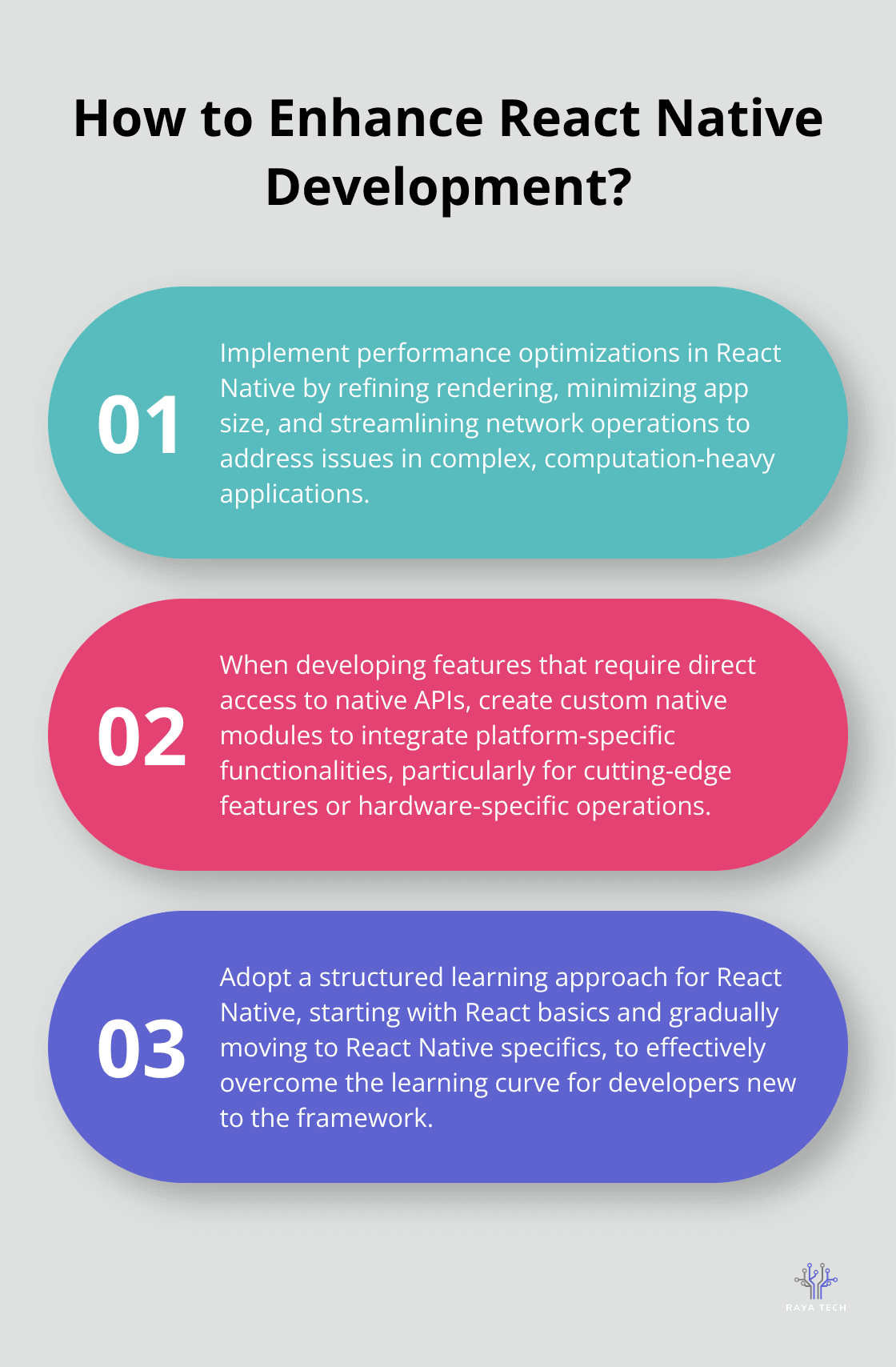
React Native can struggle with performance in complex, computation-heavy applications. To address this, developers can employ strategies to refine rendering, minimize app size, adeptly handle memory, optimize code, and streamline network operations.

Developers often need to implement performance optimizations or write critical sections in native code to address these issues. This hybrid approach can add complexity to the development process (potentially negating some of the time-saving benefits of using React Native).
Limited Access to Native Features
Despite React Native’s extensive capabilities, accessing certain platform-specific features can prove challenging. The framework’s abstraction layer, while beneficial for cross-platform development, can sometimes limit direct access to native APIs. This limitation becomes apparent when dealing with cutting-edge features or hardware-specific functionalities.
For instance, developing an augmented reality app with React Native might require creating custom native modules due to limited support for ARKit and ARCore. This process demands expertise in both React Native and native development, which can increase project complexity and development time.
Third-Party Library Compatibility Issues
React Native’s ecosystem is vast, but it’s not without its problems. The rapid evolution of the framework can lead to compatibility issues with third-party libraries. Updating React Native can sometimes break dependencies, forcing developers to either delay updates or spend significant time fixing incompatibilities.
The results of a recent survey on third-party library issues in React Native are expected to be published in the second half of January 2024, which may provide more current insights into this challenge.
Learning Curve for React Newcomers
For developers new to React, mastering React Native can be challenging. The framework requires a solid understanding of React principles, JavaScript, and mobile development concepts. This can be particularly difficult for teams transitioning from native development or other cross-platform frameworks.
To overcome this, developers should adopt a structured learning approach, starting with React basics before moving on to React Native specifics.
Final Thoughts
React Native has transformed mobile app development with its cross-platform capabilities and cost-effectiveness. It excels in rapid development scenarios, making it ideal for startups and businesses seeking quick launches of MVPs or moderately complex apps. The framework’s large community and ecosystem provide extensive support and resources, enhancing its appeal for developers and companies alike.

Despite its strengths, React Native faces challenges in complex applications and native feature access. Performance issues and third-party library compatibility can complicate development processes. The learning curve for React newcomers also requires investment in training and skill development.
At RayaTech, we leverage React Native to create efficient, high-quality mobile solutions that meet diverse business needs. Our expertise in mobile app development with React Native allows us to deliver innovative cross-platform applications. As the framework continues to evolve, it remains a valuable tool for creating compelling mobile experiences in many development scenarios.